The Town After Closing Time: What Four Weeks on the Final Bus Revealed
I have a confession: I started catching the last bus home as a sort of experiment. Not because I needed to — I could have walked, or paid for a taxi, or done the sensible thing and stayed in. But I wanted to know what a UK town looks like once the shutters are down and the streetlights are doing all the talking. So for four weeks I made the 23:47 my regular. Same route, same driver most nights, same strange little theatre of people getting from one end of the day to the other.
What I found wasn't grim. It was oddly comforting. In 2026, when so much of a town feels designed for the version of itself it wants you to see — the branded high street, the tidy market square, the Instagram-ready bit by the river — the last bus is the opposite. It is not trying to impress anyone. It is just a lit-up box on wheels, doing its rounds.
The 23:47 Is a Different Town
The first thing you notice is how quiet the pickup points are. The bus stop outside the shopping centre, which at midday has a queue and a vague sense of purpose, is now just a Perspex shelter with one person in it. A nurse coming off shift. A lad with a kebab box. A woman folding a cardigan over her arm like she's been somewhere important and is now done with it.
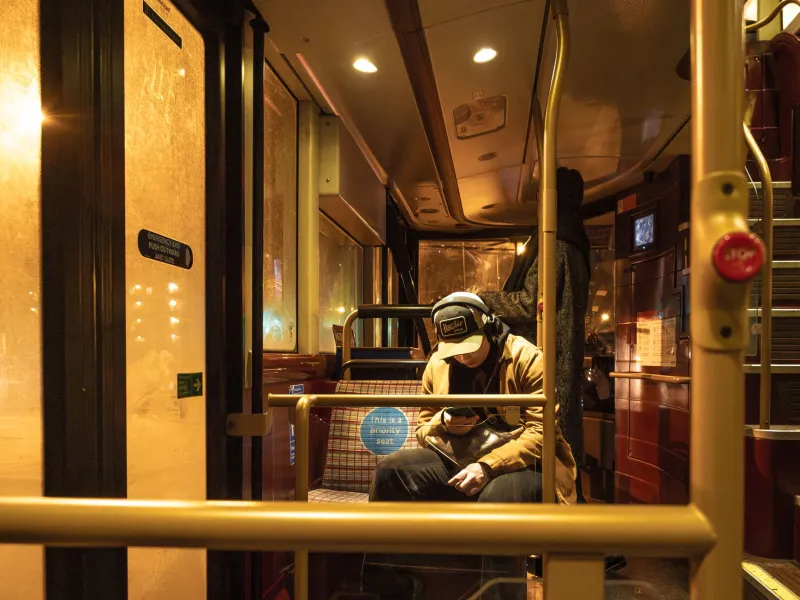
The bus itself has a different atmosphere, too. Nobody is performing. The overhead strip lights make everyone look like they're in a low-budget film from the 1980s, but that's part of the charm. The seats are the same slightly tired blue fabric as always. The floor has the same collection of receipts and crisp packets. But the conversation is different. At 23:47, people talk in murmurs. They talk to the driver like he's a priest. They talk to strangers like the bus is a confessional with a timetable.
Cash, Cards and the Driver's Patter
There is a ritual to boarding. The driver — let's call him Ray, because every town has a Ray, and mine does — has developed a patter that is somewhere between customer service and a benign security check. "Evening, love." "Alright, mate." "You're cutting it fine tonight." He knows the regulars. He knows which stop they get off at without them pressing the bell. He knows who pays cash and who taps a phone. The exact-change people — and there are still a few — have a little dance with their pockets at the door. Ray waits. He never sighs. That's professionalism.
The thing I hadn't expected was how much the bus acts as a sort of night-time switchboard. Ray gave directions to a group of students who had missed their stop. He radioed ahead about a passenger who needed the ramp. He told one woman that the pharmacy on the corner opened at eight, not seven, so she shouldn't rush. It was a better public information service than most websites. And none of it was written down.
The Back Seat Is a Confessional
They say the back seat of a bus is where the truth happens. On the 23:47, that's mostly true. One night a man in a suit sat at the back and cried quietly into his phone while pretending to read a text. Another night two teenagers spent the whole journey trying to impress each other with stories about people I suspect didn't exist. A woman in her fifties told me — unprompted, after I asked if she'd had a good evening — that she'd just been to see her mum in a care home and the bus was the only bit of the day she could breathe.
Nobody knows each other. That's the point. The last bus is a room full of strangers who have agreed, without saying so, to be temporary company. There's no small talk about the weather. There's no networking. There's just a shared understanding that the day is over and the upright bit is nearly finished.
What the Final Bus Knows
After four weeks, I started to see the town differently. The high street is a lie at 9 p.m. It says 'we are closed' and 'we are still here' at the same time. The night bus says something simpler: 'I am the last one, and I am going home.' That's not a complaint. It's a fact.
I don't want to romanticise it too much. The last bus can be lonely. It can be cold. It can be cancelled at short notice, leaving you in a doorway in the drizzle, reconsidering your life choices. But there's something genuinely decent about a service that runs when nobody's watching. It's the same reason I like local radio at midnight or the corner shop that stays open later than it should. It's not glamorous. It's just honest.
And in a year where so much of our culture feels algorithmically sharpened for our attention, that honesty feels like a small luxury. I'd rather have Ray's exact-change patience than another personalised recommendation. I'd rather have the 23:47 than another night out pretending the town is something it isn't.
The experiment is over, but I'm still catching the bus. Sometimes the best way to understand a place is to let it take you home when it thinks no one is looking.