Ladle Diplomacy: What a Sunday Carvery Still Teaches a Room Full of Strangers
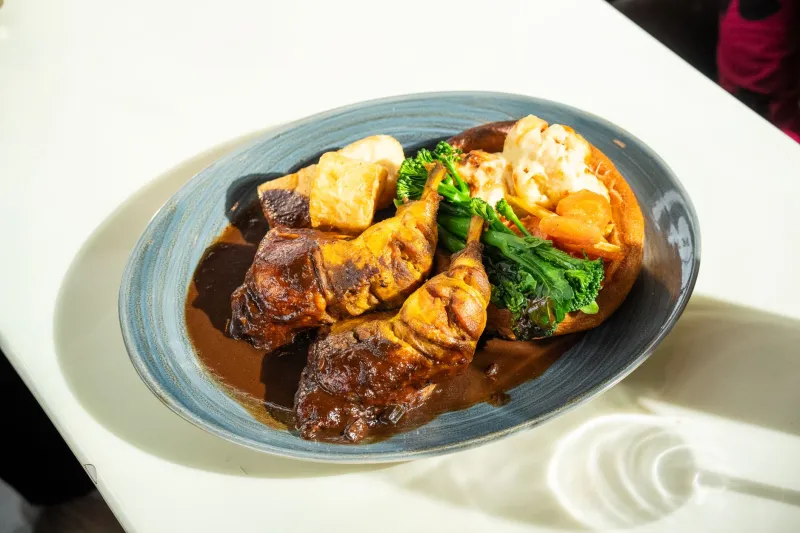
Sunday, quarter past one, and the carvery is doing what it has always done: turning a room of people who have nothing in common into one slow, shuffling organism with a shared goal and a slightly damp plate.
You know the building. A pub-hotel on the ring road with a function room, a car park containing a pothole everyone locally refers to by name, and laminated menus that have not been redesigned since the carpet was. In 2026 that isn't a failure of ambition. It's the whole pitch. Nobody books a carvery hoping to be surprised.
The queue does the introductions
Here's what I keep coming back to. The queue at a carvery is possibly the last queue in Britain where nobody is performing. There's no pre-order, no QR code, no app quietly judging your choices. You stand behind a man in a football top and in front of a couple in matching fleeces, and for eleven minutes you are all exactly the same amount of hungry.
It's a great leveller in the most literal sense. The retired teacher, the bloke who's brought his three kids because his wife is on nights, the table of six doing a birthday with one paper cracker between them — all of them get issued the same plate and sent down the same line.
The bloke carving knows it. He has a knife the length of my forearm and the calm of a man who has heard every possible joke about portion sizes and no longer reacts to any of them. "Bit of the crispy end?" he asks, and it's less a question than a ritual. You say yes. He gives you the crispy end. Somewhere in there is a peace treaty nobody signed.
The Yorkshire pudding question
Then comes the sign. There is always a sign. Last week's read: One Yorkshire pudding per adult, please.
Now, I want to be measured about this. I understand the economics — batter is cheap, oil is not, and nothing on a carvery counter disappears faster. But the wording is doing a lot of work. "Per adult" opens a door of ambiguity that a room full of grandparents, teenagers and one extremely motivated eight-year-old will walk straight through. Does a fourteen-year-old count? Does a six-footer who is technically still in Year 10? Who is checking?
Nobody is checking. That's the thing. The carvery operates on an honour system held together by eye contact and mild social shame.
The allocation crisis has become a small national drama of its own. There's a documentary in the way a family of four negotiates the last big one — the quiet standoff, the sacrificial "oh, you have it", the older sibling who notices and says nothing for two years. I'd rather watch that than most of what's on the streaming platforms, and I say that as somebody who genuinely likes telly.
Gravy is a negotiation, not a condiment
If the Yorkshire pudding reveals what people want, the gravy reveals what they're like.
There are the cautious ones, dribbling on a thin ribbon and then hovering, ladle aloft, waiting to see if anyone objects. There are the maximalists who drown the lot and look at you with the smug serenity of a man who has solved a puzzle. There's the separate-jug faction, who will not have their meat touching their mash's gravy, thank you very much.
And then there's the voice from further up the line, every single week: "Is that all the gravy?" It never sounds aggressive. It sounds like a genuine enquiry about national supply.
Watch the little courtesies around that jug and you'll see the whole country in miniature. People apologise for taking too much of a communal thing. They apologise for taking too little. They apologise for the ladle dripping. It is the politest cutlery-based diplomacy we still practise in public.
What fifteen quid actually buys
The carvery near me is £15.95 for the full works, £9.50 for small plates and kids eat for less than half that. In 2026, that is a price worth pausing on. It isn't cheap. Nothing is. But for a family of four it works out roughly the same as one round of mains at the Thai place, and crucially, nobody has to decide anything. There's no agonising over whether the small plates are a main or a starter, no upselling, no pausing at the wine list doing mental arithmetic with a nine-year-old watching.
The format has been quietly surviving since the 1970s pub chains worked out that a counter and a torch was cheaper than a kitchen brigade. Half a century on, it's the one bit of hospitality that hasn't been redesigned into something that needs explaining. You pay, you queue, you eat. That's it. In a year when a decent Sunday lunch is being reviewed by people who could hold the chef to account for the texture of the cauliflower cheese, there's something deeply likeable about a format that openly isn't trying to impress anyone.
The mixed room
What stays with me, though, isn't the food. It's the noise.
It's the sound of a toddler losing their grip on a plate of peas, and a grandmother saying "never mind, love, we'll get more", and the table across the way that has clearly been assembled by obligation and is somehow having a better time than they expected.
It's the couple who've obviously had a row in the car park and are eating through it in silence, and the four lads who've come straight from five-a-side and are treating the counter like a buffet in a heist film.
No reservations, no dress code, no minimum spend, no atmosphere to live up to. Just one room, one queue, one ladle, and a shared understanding that we're all here for the same modest reason: someone else is doing the cooking, and we are very grateful.
There is no restaurant in my town where you can sit in the same room as the people you'd never otherwise meet. Not a good one, anyway. The carvery does it without a strategy document, without a concept, without a single Instagrammable thing anywhere on the premises.
I'll be back next Sunday. I'll be the one asking for the crispy end and then apologising for it.