A C90 in a Shuffle World: Why I've Started Sitting Through Whole Albums Again
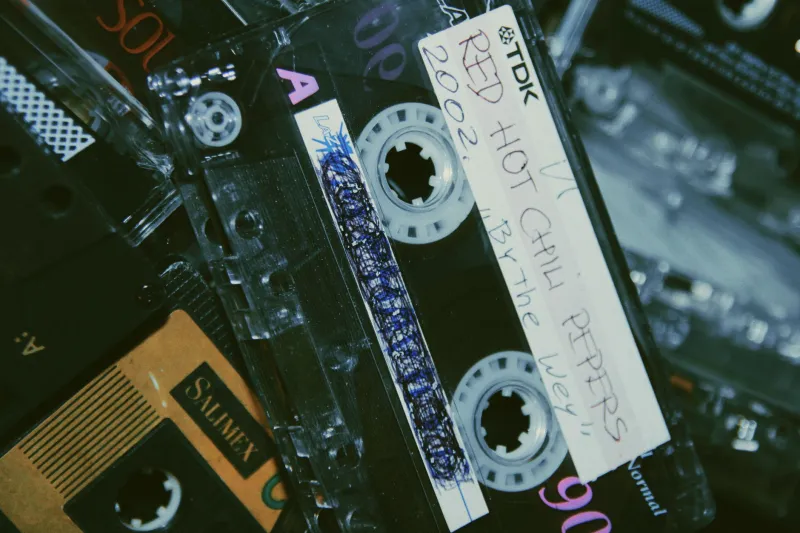
Last month, while looking for something else entirely, I found a shoebox of tapes at my dad's house. Most were labelled in biro — "MIX 3, FOR THE CAR (DO NOT LEND)", "DRIVING, SIDE A ONLY", one just said "?" — and one was a copy of Rumours with the first four seconds of the track before it bleeding in at the top, because whoever recorded it hadn't quite hit pause in time. That little smear of the previous song is the most 1993 object I own.
I didn't have anything to play them on. So I bought a second-hand deck for thirty quid from a man in a car park in Stockport, which is either the most 2026 thing I've ever done or the least, and I genuinely can't tell any more. Then I spent a fortnight driving about listening to whole sides of things, because with a cassette that is the only option on offer. You press play, and then you sit there.
The Pencil, the Hiss, and the Long Way Round
For anyone who missed the format: a C90 gives you 45 minutes a side. A C60 gives you 30. A C120 gives you 60, and also a tape so thin it will inevitably be eaten by the machine, which is roughly the cassette equivalent of buying a car with no brakes because it was cheap.
What I'd forgotten is how much of the experience was tactile admin. The pencil in the spool to wind back a slack loop. The little notch you taped over to stop your mate recording over your compilation. The hiss, which your ears stopped noticing after about ninety seconds and then noticed enormously the moment you switched the deck off. Dolby B, whatever it actually did, and the fact that nobody I knew ever knew what it actually did.
And then the flip. Forty-five minutes and the music stops, mid-air, and you physically turn the thing over. Some later decks did it for you with auto-reverse, which was a marvel and also, quietly, the beginning of the end of the ritual. Once the machine could flip itself, the flip stopped being an event and became a setting.
Sequencing Was a Physical Skill
Here's the thing the shoebox reminded me of. Side length wasn't a number on a spreadsheet — it was a wall. Artists, and more often blokes with a biro, had to decide what landed at the end of side A. Did you close on the big one and let side B open gently? Did you leave a cliffhanger? Did you put the long one last because nobody was going to skip it anyway?
My dad's tapes are full of these decisions. Side A of one ends on a quiet track I'd never have chosen, and side B opens with something loud enough to wake the street. That wasn't accident. That was someone, in about 1991, thinking about the drive home.
Streaming has no wall. There's no forty-five-minute cliff edge, no forced pause, no moment where the record says "right, that's enough for now, come back to me." You can put all of it on one infinite playlist and never once think about what belongs where. Which is freedom, technically. It's also a bit like being handed an unlimited buffet and slowly forgetting what hunger feels like.
The Flip Is the Point
I'm not going to pretend that skipping a song is a moral failing. It isn't. Shuffle is genuinely brilliant for a party, for a long drive, for finding a band you'd never have searched for. It's a grazing tool and it grazes well.
But grazing is what it is. Shuffle optimises for the next good bit. It doesn't care about the arrangement, the slow build, the track that only works because of the one before it. It hands you the greatest hits of your own taste, over and over, and after a while your taste stops being a thing you have and starts being a thing an algorithm has on your behalf.
The cassette, by contrast, is stubborn. Halfway through side B of something you're not sure about, your only options are to listen, or to stop the car. And I found, embarrassingly quickly, that I'd been missing the third option: sitting with a track that hadn't won me over yet. The ones I now love most from that shoebox are the ones I'd have skipped in the first thirty seconds.
A Small Experiment
I'm not suggesting anyone goes and buys a Ford Fiesta with a tape deck. But there's a cheap version of this that costs nothing at all.
Pick one album. Play it in order, top to bottom, no skipping. Do it once a week. Notice how often your thumb goes for the skip button before your brain has caught up. Notice what happens when you don't let it.
Or, if you want the full experience: buy a blank C90, spend an evening recording something for a friend on it, and write the label in biro. It'll take you forty-five minutes a side. You'll have to think about the running order. And they won't be able to shuffle it, which, honestly, is the whole gift.