The Rack That Doesn't Know Me: An Afternoon Off the Algorithm

Photo by Photo by Noralí Nayla on Unsplash on Unsplash
On a wet Saturday in November 2026, I did something that felt faintly rebellious: I left the house with no watchlist, no queue, and no intention of asking an app what to watch next. My plan was a charity shop run for a paperback and maybe a mug. I came home with four DVDs, a dented box set of a sitcom I'd never heard of, and a renewed suspicion of anyone who says personalisation is the same thing as taste.
The shelf has no memory of me
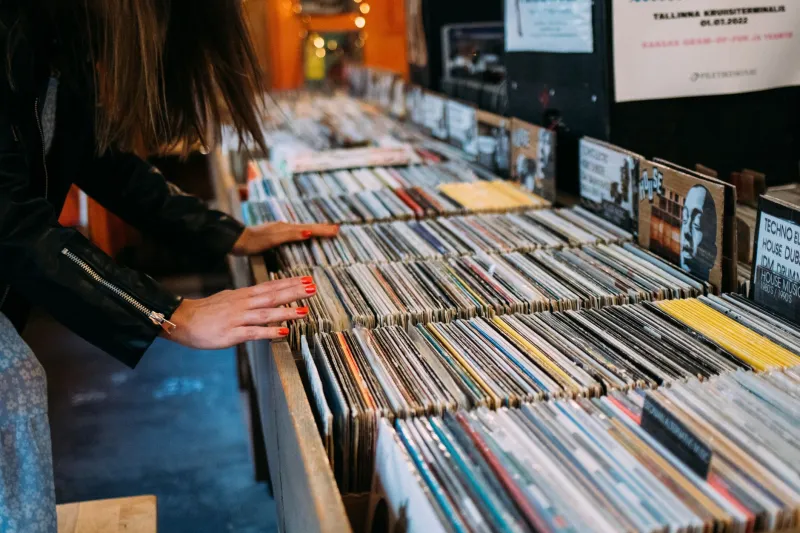
The DVD rack in a British charity shop is a strange and glorious thing. It is not curated. It is not ranked. It does not know that I watched three episodes of a Scandinavian drama and bailed, or that I once gave a five-star rating to a film I have not thought about since. It is just a shelf of objects that other people were finished with. Someone's nan cleared out a cupboard. Someone else moved house and couldn't justify another box. A car boot sale went wrong. The result is a wobbling row of plastic cases with stickers on them, and every one of those stickers is a small invitation to take a chance.
I spent about twenty minutes on my knees, which is the correct posture for this kind of browsing. I picked up a film because the cover had a yellow car on it. I put it back because the blurb mentioned 'a journey of self-discovery'. I picked up a two-disc edition of a cult British comedy series because the spine was faded and the back cover had a quote from a newspaper I'd never read. That is not an algorithm. That is a conversation with a stranger's leftovers.
Fifty pence is a creative brief
The prices help. Most of the DVDs were a pound; a few were fifty pence. At that price, the stakes collapse. You are not committing to a six-part prestige drama that you feel obliged to finish so your recommendations don't get confused. You are buying a punt. If it's terrible, you have lost less than the price of a coffee and gained a story about the time you watched a regional detective show from 2004 with a plot that made no sense. If it's brilliant, you have found something no one is talking about in 2026 because it is not on any platform's front page.
That low-stakes feeling is the point. Streaming queues are designed to reduce friction, but they also reduce surprise. The algorithm learns what you finish, what you abandon, what you click at 11pm and regret. Over time it builds a version of you that is coherent and predictable. The charity shop shelf builds a version of you that is curious. It doesn't care if you finish. It doesn't even know you started.
Cult telly by accident
I came away with a DVD of a 1990s sketch show I'd only known by reputation, a film about a football manager that I'm still not sure was a comedy, and a documentary about a seaside town that looked like it had been shot on someone's camcorder. None of these were recommended to me. That is why I watched them. The sketch show had a running gag about a man who reviewed crisp flavours; the football film had a scene in a chip shop that went on for four minutes; the documentary had interviews so awkward I had to pause it. None of it was 'content'. It was just stuff people had made, passed on, and forgotten.
There is a particular pleasure in watching cult British telly that has fallen off the map. It reminds you that culture is not a library with a perfect search function. It is a skip. Things get lost. Things get rescued. A DVD shelf in a charity shop is a tiny archive of bad decisions and happy accidents, and you are allowed to rummage through it without leaving a data trail.
The algorithm wants completion; the shelf wants a punter
I am not anti-streaming. I pay for enough of it. But there is a difference between being served and being let loose. The algorithm wants completion rates, engagement, retention. The shelf wants a punter who will hand over a pound and take a chance. One is optimised for keeping me on the sofa. The other is optimised for getting me out of the house on a wet Saturday and into a room that smells faintly of old paperbacks.
By the time I got home, the rain had stopped. I made a cup of tea, put on the sketch show, and watched two episodes. They were uneven. One sketch landed; three didn't. I didn't feel the urge to rate it, skip it, or add it to a list. I just watched it, then went to make another cup of tea. That felt more human than any personalised queue I've opened in 2026.
A low-stakes way to find a plot twist
If you are stuck in a viewing rut, try this: go to a charity shop with a fiver and no list. Give yourself ten minutes. Buy whatever has the strangest cover or the most faded spine. Watch it without checking reviews. You are not looking for the best film of the year. You are looking for an afternoon that doesn't feel like it was designed by a recommendation engine. The shelf won't know your watch history. That is the best thing about it.